Travis Oilton
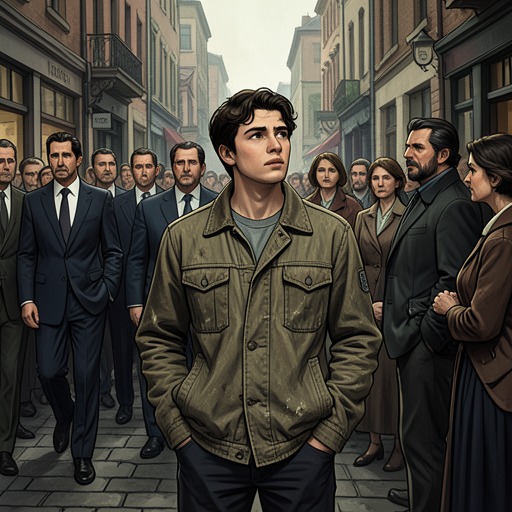
The Legend of William OhTravis Oilton is a highly specialized Climber whose defining talent is to make himself the center of danger. As a Master Decoy, he converts taunts, speed, a whip, and enemy attention into practical control over chaotic fights. His introduction presents him as both comic nuisance and serious combatant: he attacks William Oh as an audition, then abruptly offers friendship when the spar is over. That volatility eventually resolves into usefulness when the party needs someone fast and durable enough to lure a deadly threat, but Travis remains marked by the destruction of his family and the collapse of Oilton.
Identity and Combat Role
Travis introduces himself by name after putting away his weapons, gingerly crossing the ice, and offering William Oh a hand. The gesture is deliberately disarming only because it follows an unexplained assault. When William Oh studies the offered hand suspiciously, Travis explains that the fight is finished and that he wanted to discover how capable William Oh was. His first appearance therefore establishes a characteristic contradiction: he is aggressive enough to attack a stranger, yet casual enough to treat the encounter as a normal test.
His formal build gives that behavior a mechanical logic. Travis identifies himself as a Master Decoy, with Taunt Abilities and a passive ability whose effectiveness depends on the number of enemies facing him. His colorful riding crop, The Irritating Whip, tilts opponents and strengthens Charm Abilities. An Attack Speed ring and an amulet that increases his off-hand Strength make the whip more effective for blocking and disarming. The equipment does not merely decorate his personality; it externalizes it. Travis fights by irritating, redirecting, and obstructing rather than by relying on a straightforward exchange of blows.
That build also has a clear limitation. After Travis crosses the ice, William Oh tells him that he needs better footing, and Travis admits that he has only just noticed the problem. The exchange punctures his confidence without invalidating his skill. His abilities are effective, but they require terrain, movement, and control of attention to work at their best.
From Provocateur to Party Asset
Travis’s first relationship with William Oh and Loth is adversarial. He and Carrie appear as unexpected complications rather than allies, and Carrie later asks whether William Oh needs additional Party members. William Oh does need more members, but refuses because people who randomly attack him merely to audition are not trustworthy recruits. The refusal captures Travis’s early status: famous enough to attract challengers, entertaining enough to be memorable, but too erratic to be accepted immediately.
The connection does not disappear after that rejection. Halfway through a night trek, William Oh and Loth encounter Carrie and Travis cooking a giant beetle in its own shell. Carrie says that she and Travis thought the two travelers were dead, while Travis treats the situation with irreverent suspicion, suggesting that the missing pair may have bypassed loot and gone straight into a free-for-all. Their reunion preserves the same mixture of practical survival, mockery, and mistrust that defined the ice encounter.
Travis’s tactical value becomes clearest during the crisis involving the Tangled. William Oh asks about the curtain of death that the group previously fled and proposes bringing it to the Key Site, where it could provide the necessary firepower to reduce the Tangled population. Loth recognizes that moving the threat would be difficult, and William Oh identifies the missing requirement: someone must keep its attention for an extended period while moving quickly and using a Taunt Ability. The implication points directly to Travis. His habit of making himself impossible to ignore becomes, in this context, the exact capability the larger operation needs.
The same plan depends on other material actors as well. Carrie asks how an explosion of steam can be produced, and Loth explains that flow controls can restrict the water until natural heat builds again, after which the stored water can be released at once. Loth also prepares fireproof rope and assembles wire and springs. Travis is therefore not a solitary hero in the scheme; his decoy work is one link in a network involving the Tangled, the Key Site, water infrastructure, heat, rope, and improvised engineering. His contribution is the dangerous human element that makes the machinery and landscape usable.
Grief, Oilton, and the Wyrd Army
Travis’s bravado conceals a more complicated connection to the Wyrd family. He argues that an army could not have reached the fallen city within a week unless it had already been prepared before the city fell, concluding that the Wyrd orchestrated the collapse. His accusation gives the political disaster a deliberate cause rather than treating the invading force as an accidental aftermath.
William Oh recognizes the emotional contradiction in Travis’s position: Travis is enraged that the Wyrd took his family from him, yet also grateful that he will never again have to deal with them. Travis nearly loses control before acknowledging that the situation is complicated. He still intends to kill as many of the Wyrd as possible, but his revenge is accompanied by immediate material concerns. After receiving boots and a cloak, he predicts financial distress and asks whether the equipment can be traded back for cash. The moment refuses to separate grief from pettiness or vengeance from economics. Travis can be a bereaved survivor and a practical opportunist in the same breath.
His name also becomes a weapon. In the later confrontation, William Oh hears Travis shouting at a giant enemy, identifying himself as Travis Oilton and declaring that he has ruined its day. The taunt is followed by the jingle of his whip, a massive burst of fog from the Cloak of Misty Escape, and Travis’s rapid emergence from the cloud. The scene turns self-announcement into battlefield action: naming himself draws attention, the whip sustains it, the cloak creates a screen, and speed carries him out of the danger zone.
Narrative Function and Significance
Travis embodies the book’s recurring conversion of apparent weakness into specialized utility. His method looks unserious because it depends on irritation, theatrical speech, and a colorful riding crop, yet the same qualities allow him to occupy the enemy’s attention when a conventional fighter could not. He is not simply comic relief attached to a battle build. He is a demonstration that survival in The Tower depends on understanding how abilities, equipment, terrain, and enemy behavior interact.
His arc also bends the familiar pattern of the rival who becomes an ally. Travis does not first appear as a misunderstood friend waiting to be recognized; he earns attention by attacking William Oh, loses the chance to join the Party because of that recklessness, and later proves his worth through a role no one else can easily perform. His eventual usefulness does not erase the distrust created by the audition, and his revenge against the Wyrd remains entangled with unresolved grief and financial calculation.
Most importantly, Travis makes attention itself a form of power. The Master Decoy’s central resource is not invisibility or overwhelming damage but the ability to decide where danger looks. Across the ice, the Tangled crisis, and the final fog-shrouded provocation, he repeatedly turns being noticed into a tactical advantage. Travis Oilton therefore stands at the intersection of performance and violence: he jokes, taunts, and complains, but every gesture helps determine who is attacked, who can escape, and whether a larger plan has any chance of succeeding.